
Dental Implants in Syracuse, Oneida, Fayetteville & Camillus
Do you have questions on Dental Implants? Book a meeting with our Implant Coordinator!
What are dental implants?
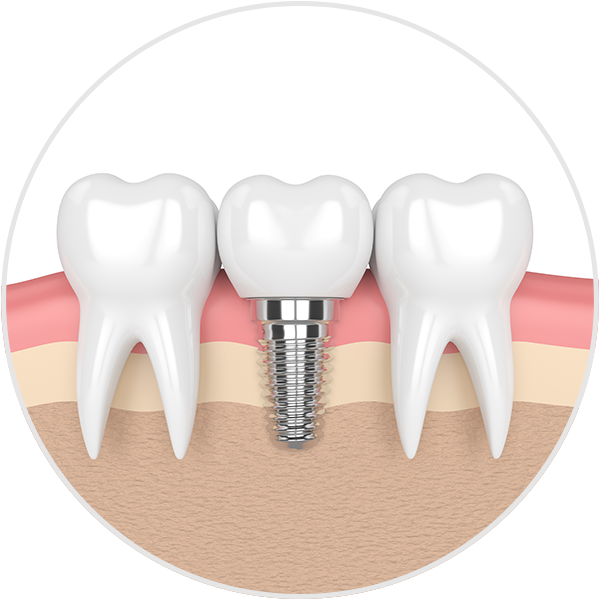
A natural tooth consists of a root and a crown. If you compare natural teeth to implant-supported replacement teeth, you’ll see they have the same basic parts. Both have a crown (the visible part used to chew food). Both have a root that holds the tooth securely under the gum and is anchored into the jaw. The difference is that the implant is made of titanium – the same time-tested material used by surgeons for artificial joints. When you lose a tooth, you lose both the root and the crown. To replace the tooth, the surgeon first replaces the root with a dental implant.
Ready to Complete Your Smile with Dental Implants?
Contact one of our offices today!
North Syracuse North Syracuse Office Phone Number (315) 458-8680
Fayetteville Fayetteville Office Phone Number (315) 637-4476
Contact one of our offices today!
North Syracuse North Syracuse Office Phone Number (315) 458-8680
Fayetteville Fayetteville Office Phone Number (315) 637-4476
Surgical Advances in Dental Implants
Dental implant placement is a team effort between an oral and maxillofacial surgeon and a restorative dentist. Dr. Scutari, Dr. Cardoso, Dr. Cunningham, Dr. Scruggs or Dr. Bourgeois performs the actual implant surgery, initial tooth extractions, and bone grafting if necessary. The restorative dentist fits and makes the permanent prosthesis. This may be your regular dentist, or a prosthodontist (dentist who specializes in restoration and dental prosthetics).
Bone Grafting for Dental Implants
Your surgeon may recommend bone grafting at time of extraction (socket preservation
graft); at time of implant placement; or, in some cases, during a separate procedure prior to
your implant surgery (usually a particulate onlay or tunnel graft).
These procedures help ensure that your implant site has enough bone to securely hold your
dental implant once it is placed. Most often, bone grafts are left to heal for 3-6 months prior
to your implant surgery.
Sometimes small membranes (coverings) are used to protect the graft temporarily—some
will resorb on their own, and some may need to be removed. Your surgeon will advise you
on which type (if any!) you have. Membrane removal is a quick procedure which usually
does not require any numbing.
Some types of bone grafting material may be held in place by a titanium mesh that is
custom-made for your mouth, and will be placed underneath your gums. After the bone
graft has healed and integrated, the mesh will be removed prior to implant placement.
These are common procedures done in our offices with either local anesthesia (numbing),
or IV sedation.
Sinus Lifts
Sometimes, in order for implants to be placed in the upper jaw (molar and/or
bicuspid/premolar areas), a sinus lift (or sinus augmentation) must be performed. This may
occur if there is not enough bone height to fit an adequately-sized implant.
A transcrestal sinus lift (sometimes called a “sinus bump”) is done at time of implant
placement. Special tools are used to gently “bump” some of your existing jaw bone toward
your sinus, in order to add a small amount of bone height to the implant site. Your implant
is then placed immediately into that site.
A lateral sinus lift is most often a separate surgical procedure, during which your surgeon
will gently access the sinus floor (top part of your upper jaw) through an incision in the side
of your gums. Bone grafting material is then placed and allowed to heal prior to implant
placement. This may be necessary if more height is needed than can be achieved with a
sinus bump, or if you are having more than on adjacent implant in that area.
Sinus lifts may require some special post-operative care instructions. Your surgeon and
clinical staff can advise you of these.
Dental Implant Placement
A dental implant is a small medical device that is most commonly placed in your jawbone
as a replacement for a missing tooth (or teeth). They can be placed in your upper or lower
jaw; they can replace a tooth that was extracted, or a tooth that has been missing since
birth (congenitally). If you have had a bone graft or sinus lift, the implants will often be
placed 3-6 months after those procedures.
Your surgeon will place the implant though an incision in your gums. The implant goes in
the jawbone and takes the place of the root of the missing tooth. Your restorative dentist
(your general dentist or a prosthodontic specialist) will place the crown (chewing part of
your tooth) after the implant has had sufficient time to heal and become integrated into
your jaw bone.
Sometimes a healing abutment is placed on top of the implant at the time of your implant
surgery. This will protect the implant, will and protrude from your gums a small amount.
These healing abutments are temporary, until your implant is ready for restoration (crown).
Other times, the gums are sutured completely over the implant and the healing abutments
are placed at a later date (usually 3-6 months). This delayed placing of the healing
abutment is called a Stage II procedure, or “second stage.”
If you are missing many teeth, implants may be used to support a bridge, overdenture, or
other prosthesis (fabricated teeth). In these cases, the implants may be spread out over
your jaw as a base for the prosthesis, rather than having individual implants and crowns for
each missing tooth.
Our surgeons have extensive experience in placing dental implants in all areas of the
mouth. These procedures may be done with local anesthesia (numbing), or with IV
sedation. Talk to your surgeon about which is best for you.
Extractions with Immediate Implant Placement
Some patients may be qualified candidates for having dental implants placed immediately
at time of extraction, instead of having to wait. This will depend on the location of the tooth,
bone structure, and other factors. Please ask your surgeon if you may be a good candidate
for immediate implant placement.
Full arch dental implants
Full arch dental implants (sometimes referred to as “All-On-X“, Teeth in a Day implants)
refer to cases in which 4-6 (or more) dental implants are spaced out across your upper
and/or lower jaws, in order to support a prosthesis. This is a great way to restore full mouth
function and also help to maintain existing jaw bone structure over a long period of time.
In many cases, our surgeons are able to do:
• extractions of remaining non-restorable teeth
• full-arch dental implant placement
• immediate/same-day placement of custom-made, implant-supported prosthesis
This is an excellent option for many patients whose dentition (natural teeth) cannot be fixed
and must be extracted. The temporary prosthesis will attach directly to your implants and
will be custom-made for you immediately after the surgery.
Please feel free to talk to your
surgeon or our implant coordinator if you have any questions about this option.
Zygomatic, pterygoid, and subperiosteal implants
These specialized types of implants are exceptionally beneficial for patients who have had
atrophy (shrinkage) of their jawbone(s) due to long periods of missing teeth, anatomical
differences, or other reasons.
Lack of sufficient jawbone can make even denture-wearing difficult, which can lead to
undue stress, weight loss (due to difficulty eating), and other problems.
Utilizing special types of implants and/or devices that can be surgically placed in your
zygomatic arch (inside your cheekbone), pterygoid bone (back of upper jaw), or
subperiosteally (using specialized custom hardware to secure the device to your jaw) can
significantly improve quality of life for patients who are not candidates for traditional
implants and/or who have trouble retaining dentures throughout the day due to lack of
bone structure.
Our oral and maxillofacial surgeons are uniquely qualified to perform these types of
procedures.
Get a Healthy & Happy Smile with our Expert Team!
Contact one of our offices today!
North Syracuse North Syracuse Office Phone Number (315) 458-8680
Fayetteville Fayetteville Office Phone Number (315) 637-4476
“Don’t be afraid to Smile.”
For years I’d felt like a part of my body was missing — because my teeth were. My dentist told me that dental implants would make me feel and look a lot better. OK, I said. Now, I’m thrilled. I can smile, eat anything, and enjoy a good laugh with my friends.
Award Winning Center of Excellence for XGuide Implants